WHO NEEDS A CONTACT LENS FITTING?
A fitting is not just for first-time wearers. You should book one if you are trying contacts for the first time, switching to a new lens type, or moving from a monthly to a daily schedule. It also applies if you have had discomfort or dryness with your current lenses, or your prescription has changed significantly. If you have searched for contact lenses near me or even contact lens near me, the fitting is the step that turns a search result into a pair you can actually wear comfortably all day.
The reason it is a separate appointment is that a glasses prescription measures how your eye focuses. A contact lens also has to match the shape of your cornea, the way your eyelids move and how stable your tear film is. Two people with identical prescriptions can need very different lenses.
THE CONTACT LENS FITTING PROCESS, STEP BY STEP
At Market Mall Optometry, the visit follows a clear order. Here is what to expect:
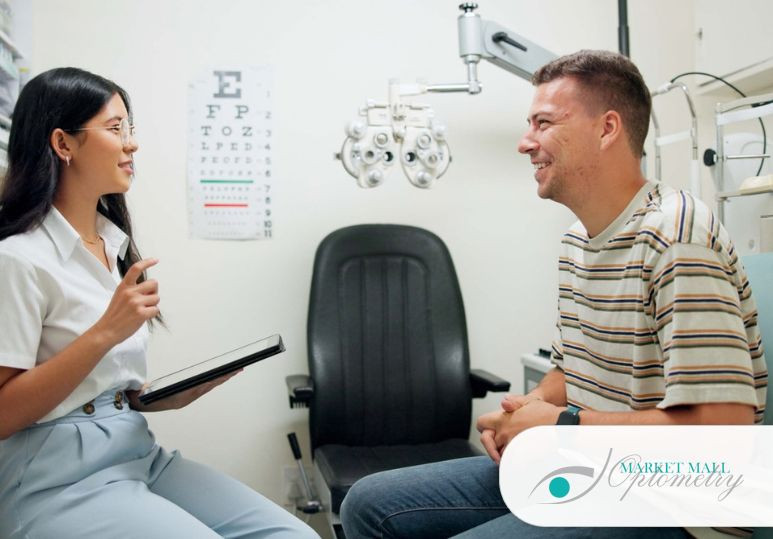
- A conversation with the optometrist about your lifestyle, work, screen time and what you want from contacts
- Measurements of your corneal curvature, pupil size and iris size
- A health check of the front of your eye and your tear quality to confirm contacts are a safe fit for you
- Selection of a lens type and size based on those measurements
- Hands-on training for inserting, handling, removing and caring for your lenses
- A pair of trial lenses to wear home
- A follow-up exam, usually within a few days, to check fit and vision
- A final contact lens prescription once the optometrist is satisfied
The contact lens fitting process is deliberately gradual. Your optometrist is not trying to pick a lens from a catalogue. They are matching a lens to your eye, then confirming it works in real life before anything is finalized.
WHAT YOUR OPTOMETRIST IS MEASURING AND WHY
Corneal curvature tells the optometrist how steep or flat the front of your eye is, which helps choose the lens curve so it centres and moves properly with each blink. Pupil and iris size matter most for lenses designed for astigmatism or for vision at multiple distances, where the optics need to sit in the right place. Tear quality matters because a lens floats on your tear film. If your eyes run dry, an otherwise perfect lens can feel scratchy by mid-afternoon, and the optometrist may recommend a different material or wear schedule.
Your answers to the lifestyle questions count just as much as the numbers. A software developer on screens for ten hours, a nurse on a twelve-hour shift and a weekend hockey player need different things from their lenses.
CHOOSING A LENS TYPE
Most people are fitted with soft contact lenses, which are comfortable from the first wear and come in several designs:
- Daily disposables: a fresh pair each day, with no cleaning
- Monthly or two-week lenses: replaced on a schedule and cleaned nightly
- Toric lenses: shaped for astigmatism
- Multifocal lenses: designed for people who need help with both near and distance vision
If you have astigmatism or need reading help, it does not mean contacts are off the table. It means the fitting is more detailed. Your optometrist will explain which options suit your prescription and eye health.
TRAINING AND TRIAL LENSES
If you are a new wearer, expect real practice time. The team will show you how to insert and remove lenses, how to handle them cleanly and how to care for them, and you will do it yourself before leaving, not just watch. Then you take a pair of trial lenses home and wear them in your normal routine: at your desk, outdoors, on your phone, in the evening light.
Trial lenses are the most useful part of the visit. They show how the fit and vision feel over several days, not only in the exam room, and give you a chance to note anything unusual to raise at your follow-up.
FOLLOW-UP AND WHAT HAPPENS NEXT
The follow-up, usually within a few days, is where the optometrist checks that the lens is sitting and moving properly, that your vision is clear and that your eyes have responded well. If something is off, they adjust the lens type, size or material and you try again. Once the fit is right, you receive your contact lens prescription and can order through the clinic’s online products page.
After that, plan on a contact lens exam every year. Eyes change, and comfort alone does not confirm that lenses are still the best choice for your eye health.
BOOKING A FITTING AT MARKET MALL OPTOMETRY
Market Mall Optometry is at 3625 Shaganappi Trail NW, next to Milestones. The clinic is open Monday to Friday from 10 am to 6 pm, Saturday from 9:30 am to 6 pm and Sunday from 10 am to 4 pm. The clinic direct bills major insurance companies for contact lens exams and lens purchases, so bring your benefits information. Book online or call 403-286-4884. Bring your current glasses and any contact lenses or lens boxes you wear now, so the optometrist can see what you are using today.
FAQs
Q: IS A CONTACT LENS FITTING THE SAME AS A REGULAR EYE EXAM?
A: No. An eye exam checks your vision and eye health. A fitting adds measurements, lens selection, training and trial lenses on top of that, so the lens suits your eye as well as your prescription.
Q: WHY DO I GET TRIAL LENSES BEFORE ORDERING A FULL SUPPLY?
A: Because a lens can feel fine for ten minutes and wrong by dinner. Wearing trial lenses for a few days shows how they perform in real life, and it lets the optometrist adjust before you commit.
Q: CAN I BE FITTED FOR CONTACTS IF I HAVE ASTIGMATISM OR NEED READING GLASSES?
A: Often, yes. There are lens designs for astigmatism and for near and distance vision together. Your optometrist will assess your eyes and recommend the best option, which may take an extra visit to fine-tune.